Forbes – Hydrogen Economy and Progressive Companies
By Ken Silverstein, in Forbes
Sebastian-Justus Schmidt is zeroing in on the hydrogen economy because, in his words, he wants to make the world a better place. The company he founded is called Enapter, and it is two years old. Its goal is to make a better mousetrap — one that produces hydrogen from a carbon-free source and in doing so, displaces fossil fuels.
The preponderance of energy produced is provided by fossil fuels. But Schmidt believes the future of energy is tied to renewables, which are vital to the production of green hydrogen that can be used to create electricity and synthetic fuels. And the end product is ultra-clean. The goal is to address climate change practically and inexpensively.
“Someone has to do something good, and that is needed,” says Schmidt, who spoke to this reporter at his company’s hydrogen conference — ‘The Big Thing’ — in Pattaya, Thailand, on Tuesday. “The hydrogen economy is doable.”
Simply, Enapter makes an electrolyzer. That device creates an electric current that provides the energy necessary to split apart the hydrogen and oxygen from the water where it is found.
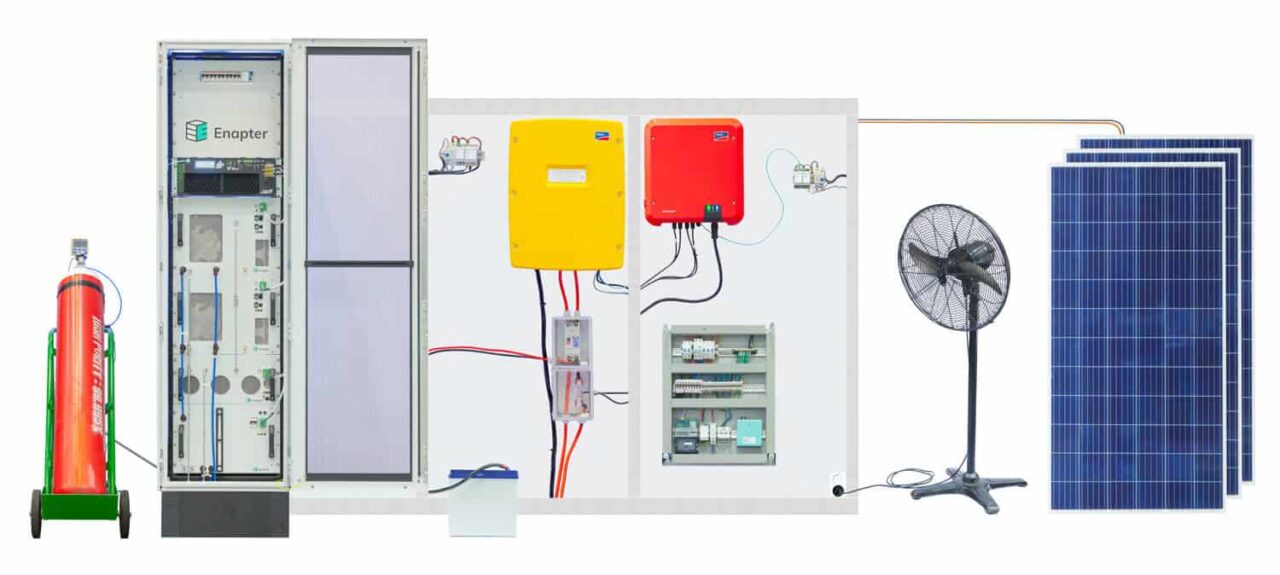
Here’s how hydrogen is used: solar panels produce electricity, which is best used immediately. But if those panels create more power than necessary, then those electrons must be stored in a battery and used in an electrolyzer that creates pure hydrogen gas. That gas is then stored in a cylinder or tank before it is piped into a fuel cell, which uses the hydrogen to produce electricity. And there are no emissions associated with it, and the only byproduct is clean water.
Critics say that the process of using solar power to separate the hydrogen before taking that gas to produce electricity results in 70% energy losses. But Enapter says that those statistics are almost irrelevant if the price of hydrogen becomes cheaper than a gallon of gasoline.
Paradigm Change
It’s a paradigm change. Instead of burning fossil fuels on demand, economies are relying more on solar and wind energy, which requires a storage device. If that solar power is used to make hydrogen, the only real energy losses stem from the sunshine that is abundant and free.
“If hydrogen can be cheaper than gasoline, there will be little need for fossil fuels. It won’t matter how efficient the conversion process is,” says Thomas Chrometzka, strategist with Enapter, in an interview.
“If you use hydrogen in a car, the driver’s experience will be the same as any type of vehicle,” he adds. “And if hydrogen is the same price as crude oil, then it is game-changing. If oil companies are not anticipating this, their eyes will be wide shut. Producing hydrogen with an electrolyzer will be the 21st Century equivalent of what upstream oil production has meant to the 20th Century.”
Chrometzka points out that a lot of progressive energy companies are taking hydrogen seriously: Thailand-based oil producer PTT Public Co. is an industry leader, he says, while the diesel engine maker, Cummins Inc., has just invested in the fuel cell maker Loop Energy.
Many experts say that green hydrogen’s true impact will occur within the next 10 or 20 years. But Enapter has a more aggressive timeline: 5 years, because of disruptive technologies. Green hydrogen produced from solar has a rough pricing point of $4 to $8 a kilogram. That’s about four times the price of a gallon of gasoline. As the various parts achieve economies of scale, prices will fall and perhaps to $1 to $1.50 a kilogram.
The Speed of Progress
In Enapter’s case, it is designing and mass-producing a scalable electrolyzer. Metaphorically speaking, instead of building “mainframe computers,” it is creating a network of personal computers. Those devices are linked through their software, which provides cloud-based data to microgrid operators, industrial complexes, and home owners that tells them whether they have the energy necessary to meet their demand and thus, when to turn on and off their electrolyzer or fuel cell.
For homeowners to be completely independent with solar, batteries, and hydrogen, they can expect to pay about $50,000. Of that, the electrolyzer will run about $10,000. But Jan-Justus Schmidt, the junior co-founder of Enapter, told this writer that it is best used in new construction rather than in existing buildings.
All of this can also work in concert with microgrids that provide localized power to hospitals, universities, and industrial complexes.
“Our goal is to make our system extremely easy to use and to integrate with all other energy devices,” says Jan-Justus Schmidt. “The hydrogen molecule is more valuable than an electron. It is so versatile, and it can be used in so many applications — everything from backing up power, to refueling vehicles, to creating synthetic fuels like methane gas. It can also be used to create synthetic jet fuel and in industrial processes such as making glass and fertilizer.”
The hydrogen economy is within grasp — the type of progress that can rollback the effects of climate change. If this phenomenon comes to fruition, then Enapter’s senior founder, Sebastian-Justus Schmidt, will have realized his dream of creating a better place for all of us to live.